
Real website audit insight
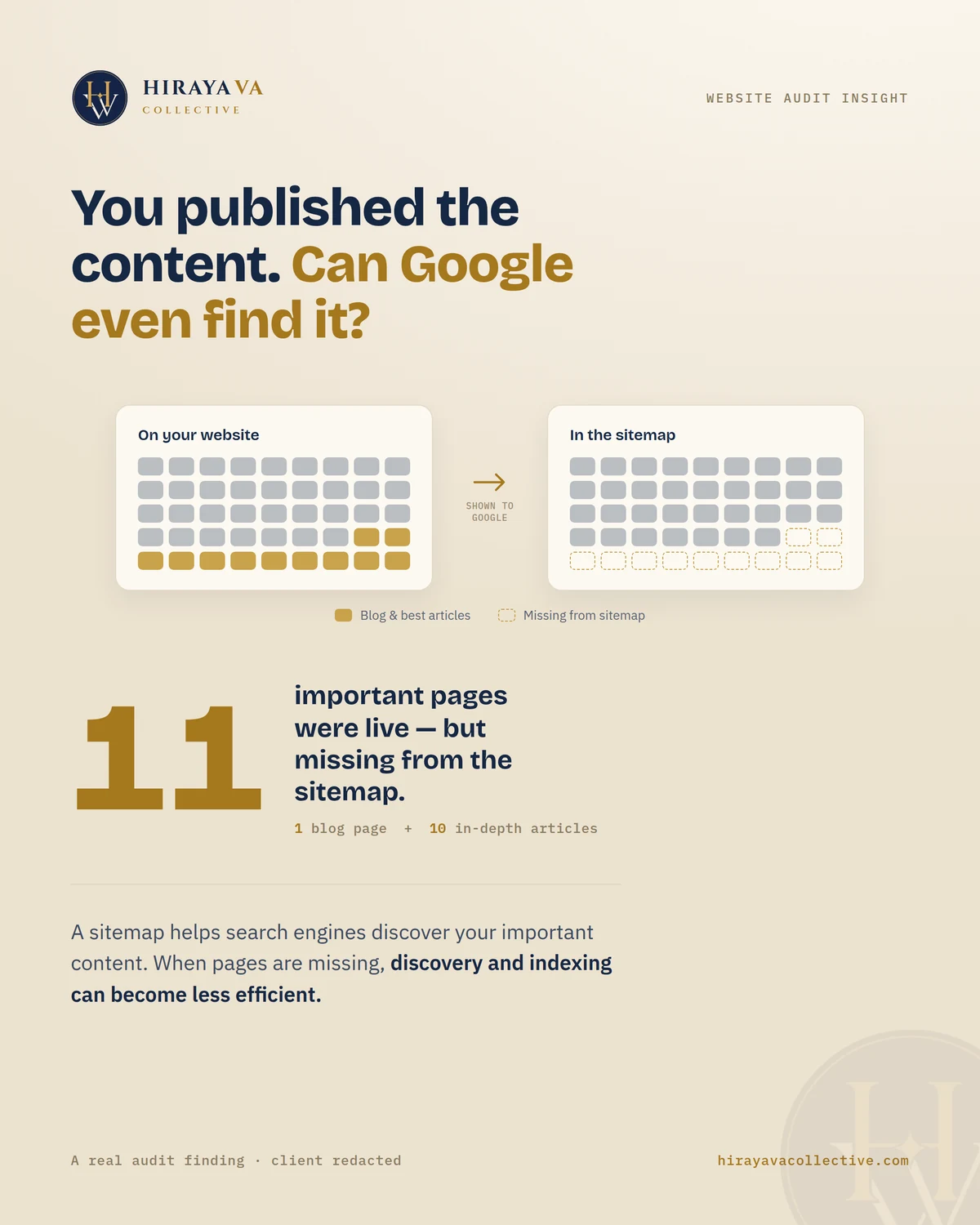
11 important pages were live — but missing from the sitemap.
A website can publish strong content and still leave important discovery signals incomplete. In this redacted audit, one blog page and ten in-depth articles were live on the site but absent from the XML sitemap.
Client redacted · · 6 min read
What we found
The content existed. The sitemap did not reflect it.
important pages were live — but missing from the sitemap.
That included one blog page and ten in-depth articles.
These were not placeholder pages. They were substantive pieces of content intended to answer real buyer questions and support the site's broader search visibility. The pages were live and available on the website, but the sitemap — the file used to tell search engines which URLs the site considers important — did not include them.
Important: being absent from a sitemap does not make a page invisible to Google. Search engines can still discover URLs through internal links and other signals. The problem is that one of the site's clearest discovery signals was incomplete.
Why it matters
A sitemap is not a ranking switch. It is a discovery signal.
An XML sitemap helps search engines understand which canonical pages a website wants discovered and crawled. That is particularly useful when a site is new, has recently been redesigned, publishes fresh content, or has pages that are not naturally reached through many internal links.
Missing URLs can make discovery and recrawling less efficient. That does not mean the content will never be found, and adding a URL to a sitemap does not guarantee indexing or rankings. It simply removes an unnecessary gap between the content a business has invested in and the signals it is sending to search engines.
For this audit, the useful question was not, “Is Google definitely ignoring these pages?” We did not have Search Console evidence to make that claim. The useful question was, “Why would we leave important content out of a file specifically designed to surface important content?”
What we would check next
Fix the sitemap — then verify the rest of the path.
A sitemap issue should not be treated in isolation. Once it is found, we check the surrounding technical signals to understand whether it is the only issue or one part of a broader discovery problem.
- Internal linking: Can users and crawlers reach the content naturally from the site's navigation, hub pages or related reading?
- Indexability: Are the pages free of accidental
noindexdirectives and blocked resources? - Canonical tags: Does each page point to the correct canonical URL rather than another version?
- Status codes: Do the pages return a clean 200 response rather than redirecting or failing?
- Sitemap freshness: Are important URLs present with accurate
lastmoddates when the content changes? - Search Console: Which URLs are discovered, crawled and indexed, and are there specific reasons Google is excluding any of them?
What we would fix
Make the discovery signal match the real website.
The immediate correction is straightforward: add the missing canonical URLs to the XML sitemap, give them accurate modification dates, and resubmit the sitemap through Google Search Console.
For important newly published or significantly updated pages, URL Inspection can then be used selectively to request indexing. After that, the work becomes measurement rather than guessing: monitor Search Console for crawl activity, indexing status, impressions and the queries that begin surfacing the content.
The goal is not to “force Google to rank” a page. No sitemap can do that. The goal is to make sure the website's technical structure is not creating avoidable friction before the content has a chance to compete.
The business lesson
Publishing is only one part of making content work.
Businesses often invest in articles, service pages and website redesigns, then evaluate the result only by what they can see on screen. SEO adds another layer: whether the site is structured so search engines can efficiently discover, understand and revisit that work.
This is why a website audit should go beyond visual design. The useful questions include what is published, how it is linked, what search engines are being told, how visitors move toward an inquiry, and what happens after that inquiry arrives.
Great content deserves more than a publish button. It needs a clean path to discovery.
Frequently asked questions
Sitemaps, discovery and indexing.
Does a page missing from a sitemap mean Google cannot find it?
No. Search engines can still discover pages through internal links and other signals. A sitemap is one important discovery signal, not the only route to a page.
Does adding a page to a sitemap guarantee indexing or rankings?
No. Sitemap inclusion helps discovery and crawl prioritization, but it does not guarantee that a search engine will index or rank the page.
Should every page be included in the sitemap?
Generally, include important canonical URLs you want search engines to discover and consider for indexing. Redirects, duplicate URLs, noindex pages and low-value utility URLs usually should not be treated as priority sitemap entries.
Keep reading
Related on the site
Digital Marketing & SEO →
SEO foundations, content planning and practical visibility work tied to business goals.
Website Development →
Websites built around clarity, search foundations and a usable path to inquiry.
More Case Studies →
Real business problems, the approach taken and the practical value of the work.
Website Redesign Checklist →
A practical checklist for planning a redesign without overlooking the structural details.